
University / Press center / News / University / News
"Arguments and Facts" Weekly — An Idea Worth a Million: How Volgograd Students Stood Out in 2026
3.08.2026
New opportunities for robotics, modern technologies for cultivating promising agricultural crops, and promotion of the country's cultural landmarks — these and other projects developed in the Volgograd region can be considered truly groundbreaking. They, along with many other developments by our talented locals, receive federal support, which helps the region grow and inspires researchers to pursue new innovations and discoveries.
A Robot with "Smart" Hands
Recently, it became known that Volgograd developers have achieved a victory. According to the Committee for Economic Policy and Development of the Volgograd Region, LLC "ROBMECHTECH" will receive a grant of 5 million rubles from the Innovation Assistance Fund.
The company became a winner of the "Start-Machine Tool Building-1" competition, presenting its development for a collaborative robotic manipulator. "Collaborative" in this context means that the robot works alongside a human — such production facilities are becoming increasingly common. Now, the company has developed a technology for adaptive sensor-based gripping for robotic manipulators.
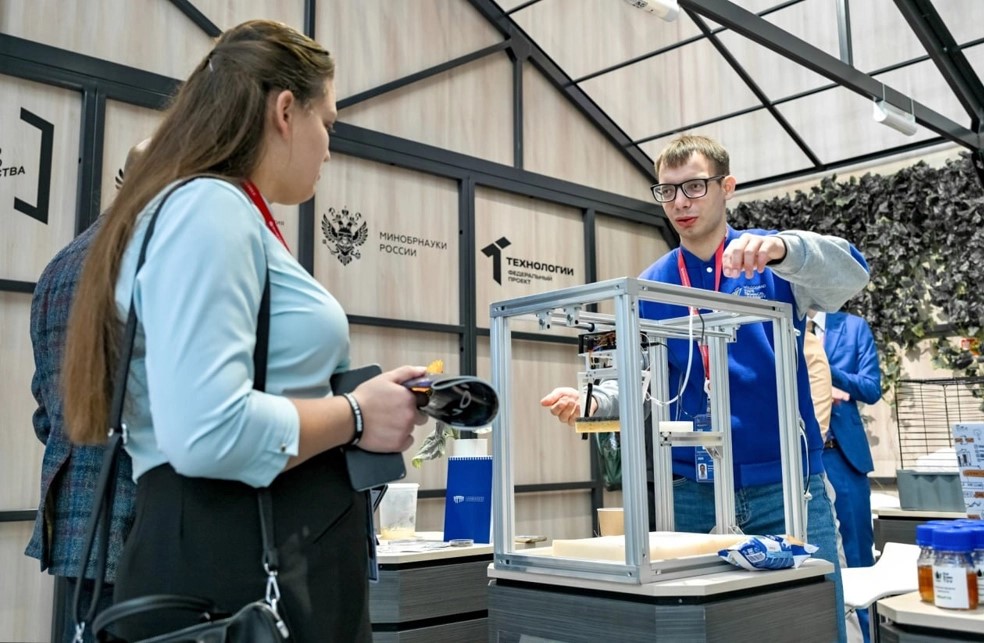
In 2026, students of Volgograd State Technical University also received one million rubles each to implement their projects. Alexander Porkhun was recognized for his project "Development of a Rotary 3D Printer with an Active Thermal Chamber." This is a 3D printer with a fundamentally new design.
In simple terms, the active thermal chamber solves a key problem: it maintains a stable temperature inside the chamber, which is critical for printing with "difficult" plastics (ABS, PC, composites). This approach significantly increases the strength of parts across layers — the difference can be 20–50%. The rotary design, in turn, achieves smoother and more precise movement of the extruder, directly affecting print quality and speed.
Roman Lovchev was recognized for his project "Development of a Hardware-Software System for Automatic Analysis of Filament Quality in 3D Printing Based on Machine Vision."
The essence is that the system will detect filament defects (the consumable material, the plastic thread used for 3D printing) before printing begins, reducing defects and increasing printing stability. The technology will be in demand in educational laboratories, prototyping, and small-batch production.
Meanwhile, Mikhail Zhunenkov will implement the project "Development of a Service for Automating Design in KOMPAS-3D Using a Multimodal Generative Model." This will be a software module based on artificial intelligence, capable of converting a text description of a part in natural language into a ready-to-execute macro (a sequence of commands) for the computer-aided design system.

