
University / Press center / News / Science / News
RIA Novosti: Scientists Have Found a Recipe for "Reviving" Dried Vegetables
9.09.2026
Russian Scientists Calculated the Rehydration Coefficient for Dried Vegetables
The nutritional value of dried vegetables can be restored to the level of fresh ones, scientists from Volgograd State Technical University (VSTU) have found as part of a research team. The authors calculated precise rehydration coefficients that make it possible to obtain a product identical in protein, fat, and carbohydrate content to fresh vegetables. The results have been published in the journal "Proceedings of the Kabardino-Balkarian State Agrarian University named after V.M. Kokov."
Drying is one of the methods of preservation that allows vegetables to be stored for many months without adding chemicals or requiring special storage conditions, which is especially important for ensuring year-round nutrition in kindergartens, schools, and social institutions. At the same time, according to the authors of the study, most scientific work on the study of drying and rehydration of vegetables has been devoted to leafy and fruit crops, whereas root vegetables and potatoes — the foundation of the Russian diet — have been insufficiently studied.
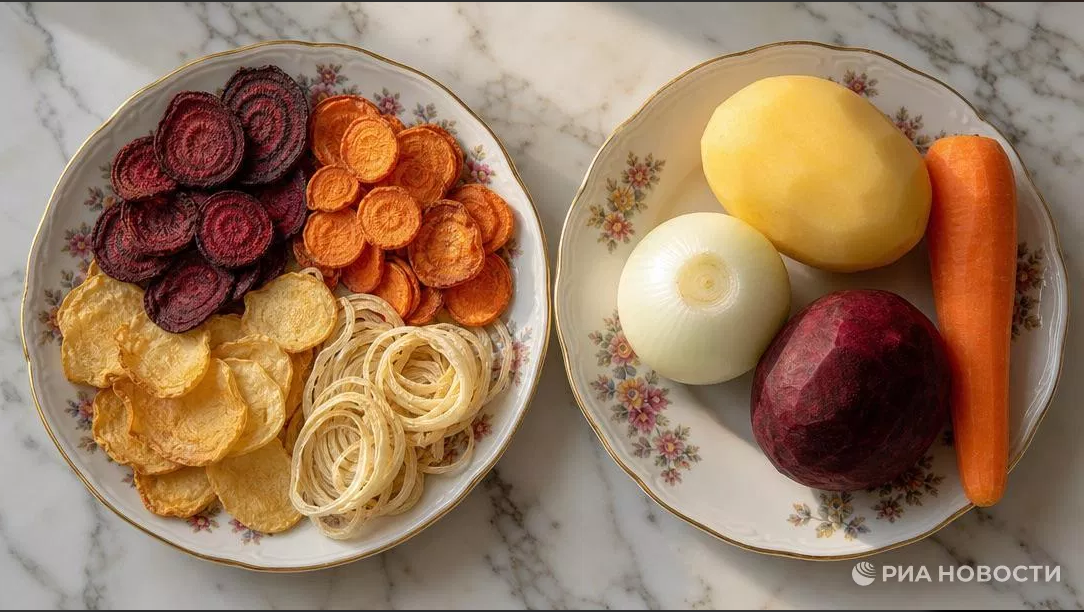
For the experiment, scientists from Volgograd State Technical University (VSTU), together with colleagues from Volgograd State University and the Kabardino-Balkarian State Agrarian University named after V.M. Kokov, selected beetroot, carrots, potatoes, and onions. The samples were dried using two methods — convective (treatment with hot air at 60–90 °C) and infrared (heating from within using electromagnetic waves at 40–60 °C).
"As the study showed, the loss of nutrients, in particular vitamin C, in vegetables during infrared drying was significantly lower than during convective drying. The retention of ascorbic acid in various vegetables ranged from 61 percent (onion) to 71 percent (potato), whereas with convective drying it was only from 48 percent to 57 percent," said Valentina Khramova, Dean of the Faculty of Food Production Technology at VSTU.
Then, based on the content of proteins, fats, and carbohydrates, the scientists calculated precise rehydration coefficients for the products — how much water needs to be added to dried vegetables so that their composition comes as close as possible to fresh ones. According to the results of the rehydration process, the correspondence in terms of main nutrients ranged from 95 to 104 percent. The figure above 100 percent is explained by the fact that rehydrated potatoes contain less water than fresh ones.
"Two popular dishes were prepared from the rehydrated vegetables — buckwheat porridge with vegetables and borscht. They underwent tasting and independent laboratory testing. The test results confirmed that in terms of protein, fat, and carbohydrate content, as well as caloric value, they are practically identical to dishes made from fresh vegetables," Khramova added.
As the authors note, the results of the study serve as a basis for updating regulatory documents on the substitution of products in the social and child nutrition system.
In the future, the scientists plan to determine how different storage conditions affect the nutritional value of dried vegetables, as well as to develop recommendations for their use.

