University / Press center / News / Education / News
The Educational Programme "Guides of Meaning. DNA of Russia" Has Launched at VSTU
29.09.2026
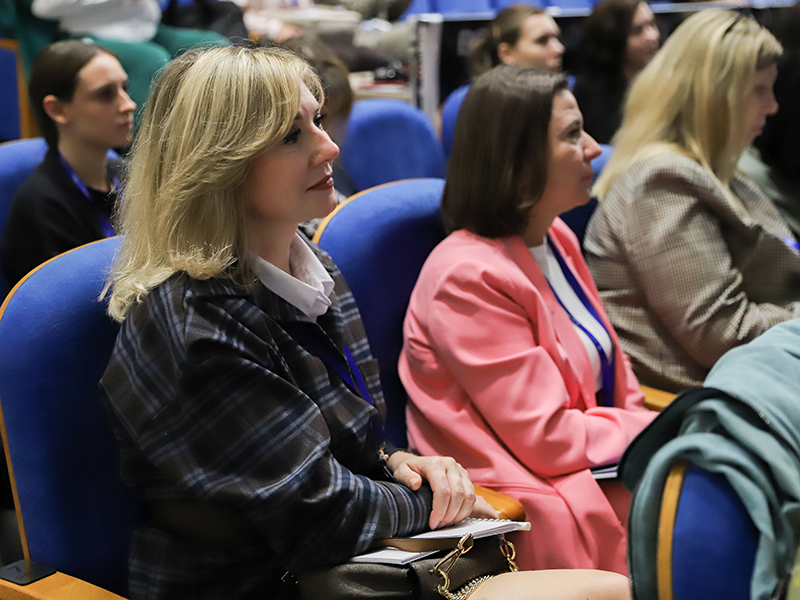
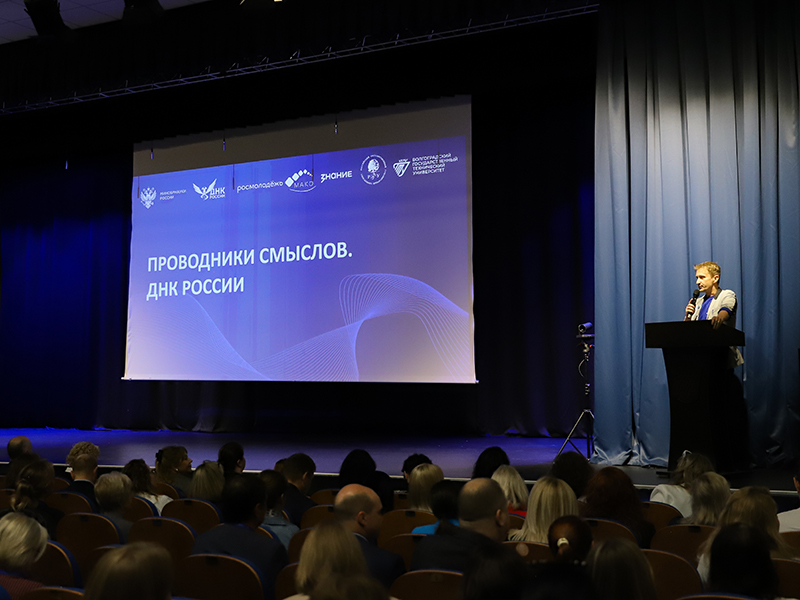
Today, 29 September, the first large-scale educational programme of the season, "Guides of Meaning. DNA of Russia," opened at Volgograd State Technical University. The event brought together teachers, university administrators, and experts from 40 educational institutions across different regions of the country to discuss the educational mission of higher education, the role of teaching communities, and the formation of ideological resilience among young people.
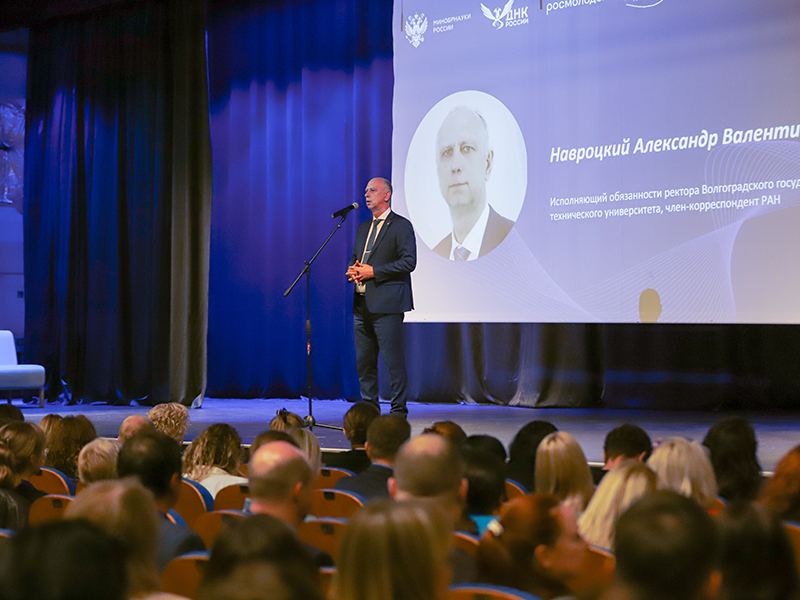
Opening the event, Rector of VSTU, Corresponding Member of the Russian Academy of Sciences Alexander Navrotskiy, emphasised the significance of the event and thanked all out-of-town participants for choosing Volgograd out of all the other locations on the map where similar programme events will be held. After all, our city, if one looks at its history, is filled with meanings that are important for the modern generation as well. First of all, this is, of course, the Battle of Stalingrad — its historical significance, its lessons, its consequences not only within the framework of World War II but in history as a whole. The earlier history of Tsaritsyn – Stalingrad – Volgograd shows that this place is a crossroads of peoples, civilisations, religions, and cultures. "We really do have a great many examples of those very meanings that can be discussed, that can be used to educate our students," emphasised Alexander Valentinovich. Addressing the participants of the event, he noted: "You have a difficult and responsible mission, because our students — our charges — will tomorrow determine everything: how industry will work, how transport will develop, how governance will be structured in our state. Whatever we instil in them is what they will do."
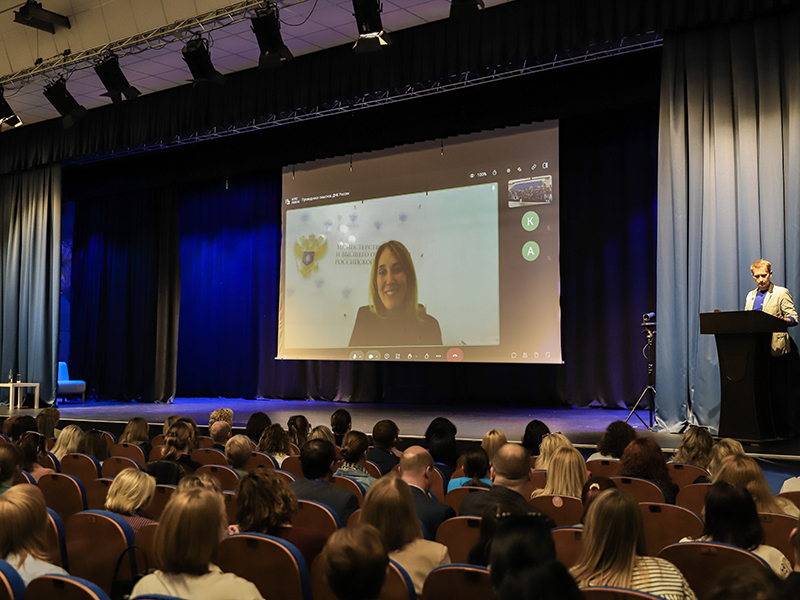
Deputy Minister of Science and Higher Education of the Russian Federation Olga Petrova addressed the university community online: "Together with you, we will try to find something new that we can bring to the environment of opportunities that exists at the university for teachers and for students: a developmental environment that allows us to understand that we are, in fact, the foundation for all aspects of our country's sovereignty — both technological and values-based." Olga Viktorovna wished everyone fruitful work, because it is often teachers who are that significant adult and personal example for students, showing how things should be done, how to make decisions correctly, and how not to be afraid to act and create.
President of the MAKO Association, Chair of the Civic Chamber of the Russian Federation Commission on Enlightenment, Upbringing, and the Protection of Historical Memory, Director of the Federal Centre for Scientific-Methodological, Expert-Resource, and Information Support of Youth Policy, and Academic Director of the "Guides of Meaning. DNA of Russia" programme, Olga Golyshenkova, identified the main goal of the meeting as fostering in students and teachers a sense of belonging to the history and future of the country: "We are in a cognitive war, where teachers are the first on the defensive lines. It is important not just to deliver material, but to radiate meanings that will help the country endure." In her speech, she gave vivid examples of the distortion of values among young professionals and emphasised the importance of preserving traditional foundations. She also spoke about the fact that today there are more than fifty Clubs of Meaning-Makers operating in universities across the country.
And this topic was continued with a concrete example by the leader of the KSS of Volgograd State University, Olga Andryushchenko. "Our club was born from below. First there was a chat of active teachers, then training in moderation, and only then the institutionalisation of the community with the support of the university administration," said Olga Evgenievna, confirming the words of the previous speaker. She spoke about the structure, interaction, and work of the club.
Within the framework of the "Guides of Meaning. DNA of Russia" programme, reports were presented on the role of state institutions and educational projects in the upbringing of the younger generation.
Alexander Vorobyov, Chairman of the Committee for Youth Policy of the Volgograd Region, emphasised that the activities of Rosmolodezh today go beyond supporting initiatives: it is becoming a strategic tool for shaping the civic position of young people through projects, grants, and interdepartmental interaction.
Head of the Department of Network and Partnership Projects of State Policy at RANEPA, Head of Department, and lecturer of the "DNA of Russia" project, Alexander Yukhno, presenting the "DNA of Russia" project, noted that the country's civilisational code is not a formal set of rules but a living complex of values that helps a young person find support and meaning in life. He focused on the need for the practical implementation of these values through joint projects of universities and society.
Ahead for the programme participants are interactive lectures, group work on designing values-oriented events, and discussion of models for internalising values.
The programme will conclude tomorrow with a presentation of the projects.